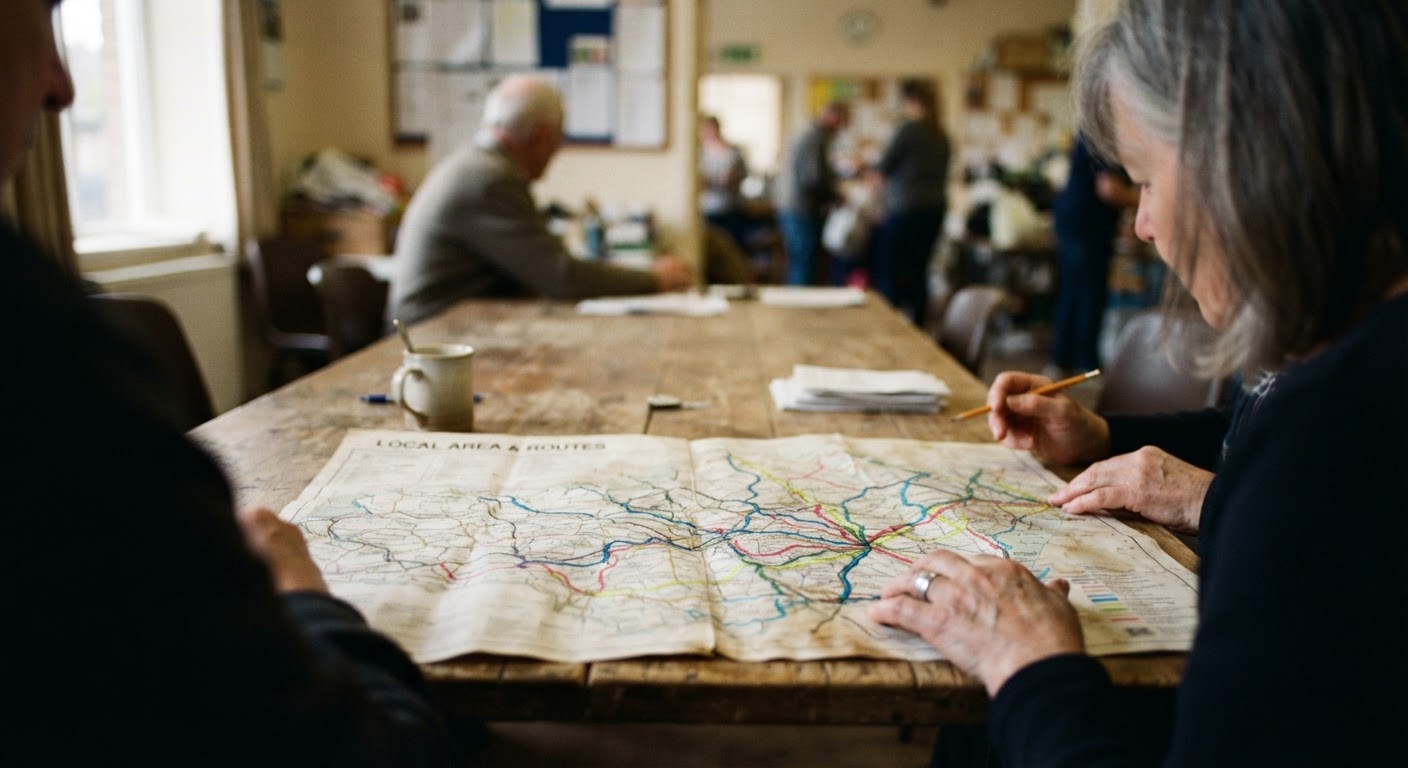
There is a whole layer of American life that runs quietly underneath the systems most people know about. It does not advertise on billboards. It does not have a single 1-800 number that covers everything. It shows up in a church basement, a converted storefront, a spreadsheet a caseworker keeps on her desk, a fund that a community foundation reshuffles every quarter. Most people never see it because they never need to. Then a car breaks down, a shift gets cut, a diagnosis lands, and suddenly they are searching for something they didn’t know existed an hour before.
Why this system is invisible until you need it
Government assistance programs are, for all their frustrations, at least legible. There is usually a name for the program, a website, a set of rules you can read even if you disagree with them. The nonprofit and charitable side of the assistance world doesn’t work that way, and that’s not an accident or a failure — it’s just a different kind of system, built by different kinds of organizations for different reasons.
A local charity might exist because a group of neighbors noticed a gap forty years ago and never stopped filling it. A faith-based aid fund might only be known to members of that congregation, or to whoever the pastor happens to think of when someone calls in need. A community grant program might have been funded by a single family foundation and only publicized through a handful of caseworkers who know to ask about it. None of these had a reason to build a national marketing presence. They exist to help the people who find them, not to be found by everyone.
That means the map of this world isn’t printed anywhere in full. It lives in the heads of caseworkers, chaplains, longtime residents, and 211 operators who have spent years learning which door to knock on for which kind of problem. If you’ve never had to ask, you’ve never had a reason to learn it. If you’re reading this because you’re stuck, you’re catching up on knowledge that other people accumulated slowly, out of necessity, and you’re doing it in a hurry. That’s a hard way to learn a system, but it helps to know at least that a system exists — that you are not failing to find help because there isn’t any, but because the help is organized in a way that rewards knowing where to look.
Local charities, faith funds, and grant programs are separate layers, not one thing
One of the most common mistakes people make when they start looking for nonprofit help is treating it as a single category, as if there’s one pool of “charity money” somewhere that a person can eventually get routed into. In practice it’s closer to a stack of different layers, each with its own logic, its own gatekeepers, and its own reach.
Local and community charities
These are the organizations most people picture first — a food pantry, a clothing closet, an organization that helps with utility shutoffs or a security deposit. They tend to be geographically bound, often to a single county or even a single town, and their resources are usually modest and specific. A local charity might be extremely good at one narrow thing, like emergency propane delivery in winter, and have nothing at all to offer for anything else. Their strength is depth in a small area, not breadth.
Faith-based aid funds
These sit alongside local charities but run on a different set of rules. Many churches, synagogues, mosques, and other congregations keep a discretionary fund meant for exactly this kind of situation — someone shows up needing help with a bill or a tank of gas or a few nights in a motel. You generally do not need to be a member of the congregation to ask, though it helps to ask respectfully and directly rather than assuming. These funds are often small, replenished irregularly, and managed by one person — a pastor, a deacon, an office administrator — who decides case by case. There’s rarely a formal application. There’s a conversation, and then either help or a referral to somewhere else. This layer is easy to miss if you’re not already connected to a faith community, but most congregations will talk to anyone who calls or walks in.
Nonprofit emergency grants
This is a more formal layer, closer in feel to a government program but run by a nonprofit or foundation. These grants tend to target a specific circumstance — a particular illness, a particular profession, a particular kind of disaster — and are often funded by an endowment or a specific donor base. They can come with real paperwork: an application, documentation, a review timeline. Because they’re more structured, they’re also more likely to be listed somewhere online or known to caseworkers, but the specifics (who qualifies, how much is available, whether the fund is even currently open) shift often enough that you should treat any listing you find as a starting point for a phone call, not a guarantee.
Understanding these as separate layers matters practically. If you call a local charity and they can’t help, that doesn’t mean the faith-based layer or the grant layer can’t. Each layer has to be checked on its own terms, because none of them fully accounts for the others.
How referral networks tie the layers together
If the layers above are the rooms in a building, referral networks are the hallways. The most well-known version of this is a 211-style referral line — a service that exists specifically to know what’s currently available in a given area and point callers toward it. These networks don’t usually have money to give out directly. Their value is knowledge: they track which food pantry is open which days, which faith fund still has money this month, which nonprofit grant just opened its application window and which one just closed it.
This matters more than it sounds like it should, because availability in this world changes constantly. A charity that was fully funded in the spring may be dry by the fall. A grant program may only take applications during a specific quarter. A referral line’s whole job is to stay current on that churn, which is something no directory or old bookmark can do as reliably.
Caseworkers, chaplains, and community volunteers often function as an informal referral network of their own, sometimes more current than the official one, because they’re making these calls every week and hearing directly from the organizations about what’s changed. If you’re a caseworker or volunteer reading this, your own accumulated knowledge — which local church still has a fund, which nonprofit just got a new grant cycle — is itself a resource that the people you’re helping usually can’t access on their own. Sharing it plainly, without assuming they already know the landscape, is often the most useful single thing you can do.
For someone looking for help, the practical lesson is this: a referral network is rarely the final answer, but it is very often the fastest way to find out which of the layers above is actually live right now in your area. Calling a general referral line before spending an afternoon calling individual charities one by one can save real time, because the person on the other end may already know that three of the five places on your list are currently out of funds.
Where to start looking before an emergency hits
The honest truth is that most people build their map of this system after the emergency has already started, which is the worst possible time to learn anything. If you have any room to look before you’re in crisis, it pays off later. A few starting points that tend to work regardless of where you live:
- Call a general referral line first. Whatever your area’s version of a 211-style service is, it’s built to be a front door into the rest of this system. Even if you don’t need anything today, it’s worth knowing the number exists and roughly how it works.
- Identify the community action agency or similar hub in your area. Many regions have a nonprofit whose specific job is coordinating local assistance efforts — they often know about faith funds and small charities that never show up in a general search.
- Ask a congregation directly, even if you’re not a member. A short, honest phone call — “I’m not part of your congregation, but I’m trying to find out if you have any kind of assistance fund” — is a normal question that gets asked all the time. You’re not imposing by asking.
- Talk to a caseworker or chaplain even when you’re not in crisis. These are the people whose job involves knowing this landscape. A conversation during a calm period can leave you with names and numbers that save you time later.
- Note what each layer is actually for. Keep a rough mental (or written) list: which local charity handles what kind of need, which congregation has a fund, which grant program applies to your circumstance. You don’t need a polished system — just enough to know where to start if something goes wrong.
None of this guarantees help will be there when you need it — availability shifts, funds run dry, and some layers will simply have nothing to offer in a given month. But knowing the shape of the system, and knowing that it’s made of distinct layers connected by referral networks rather than one single source, changes how you search. Instead of hunting for “the” place that helps, you’re checking a set of doors you already know exist. That alone tends to cut the time between “I don’t know where to turn” and “I found someone who could help,” which, in the middle of an actual crisis, is often the thing that matters most.