If you’ve spent time on hold with hotlines, filled out intake forms for nonprofit grants, or waited on a caseworker to call back, mutual aid can feel like a different language entirely. There’s no application portal. No board of directors. Often no official name you can look up on a charity registry. And that’s not an oversight — it’s the point. Mutual aid is a way of organizing help that skips the formal structures most assistance programs are built on, and understanding that difference can save you a lot of confused searching.
What mutual aid means outside the disaster-relief headlines
Most people first hear the term “mutual aid” attached to a hurricane, a wildfire, or some other disaster — neighbors handing out water and tarps while the official response is still getting organized. That’s a real and common form of mutual aid, but it’s not the whole picture, and if you’re only looking for it after a headline-making crisis, you’ll miss most of what’s actually available.
At its core, mutual aid is just people in a community agreeing to take care of each other directly, without a middleman deciding who qualifies. No caseworker reviews your situation. No income documentation gets checked against a formula. Someone needs something — groceries, a ride, a place to charge a phone, help with a utility bill, a spare car seat — and someone else who has the capacity to help, does. The exchange is horizontal: neighbor to neighbor, not agency to client.
This isn’t charity in the traditional sense, and the people involved usually don’t describe it that way. Charity implies a giver and a receiver in fixed roles. Mutual aid assumes those roles are fluid — the person who drives someone to a food pantry this month might be the one asking for a ride to a medical appointment next month. Many mutual aid networks explicitly avoid language like “donor” and “recipient” for this reason. Everyone is expected to be both, over time, even if in any given week the flow of help runs mostly one direction.
Mutual aid also isn’t new, and it isn’t only urban or only progressive-activist in flavor, even though that’s where the term gets the most media attention. Rural communities have run informal systems like this for generations — a rotating list of who plows whose driveway, who has extra garden produce, who can watch kids when someone’s shift runs long. Church potlucks that quietly turn into grocery drop-offs for a family going through a hard stretch are mutual aid, even if nobody in the room would use that phrase. What changed in recent years is that more of this coordination moved onto group chats, spreadsheets, and social media, which made it visible — and searchable — to people outside the immediate community.
How mutual aid networks organize and move money and goods
There’s no single template, but most networks settle into one of a few recognizable shapes.
The pooled fund model. A group collects money — sometimes through a simple online fundraiser, sometimes through a shared account — and then distributes it based on requests that come in. Some networks use a public form where anyone can describe what they need; a small rotating group of organizers reviews requests and sends money directly, often with no proof of need required beyond the request itself. Trust is the whole mechanism. Amounts tend to be modest and turnaround fast, sometimes same-day, because there’s no approval hierarchy to move through.
The request-and-match model. Instead of pooling cash, the network operates more like a bulletin board. Someone posts “I need X” and someone else who has X, or the means to get it, responds directly. This is common for goods (diapers, winter coats, furniture) and for services (rides, translation help, someone to sit with a person during a hospital stay). Money may never change hands between the network and the person in need — it’s a direct connection between two individuals.
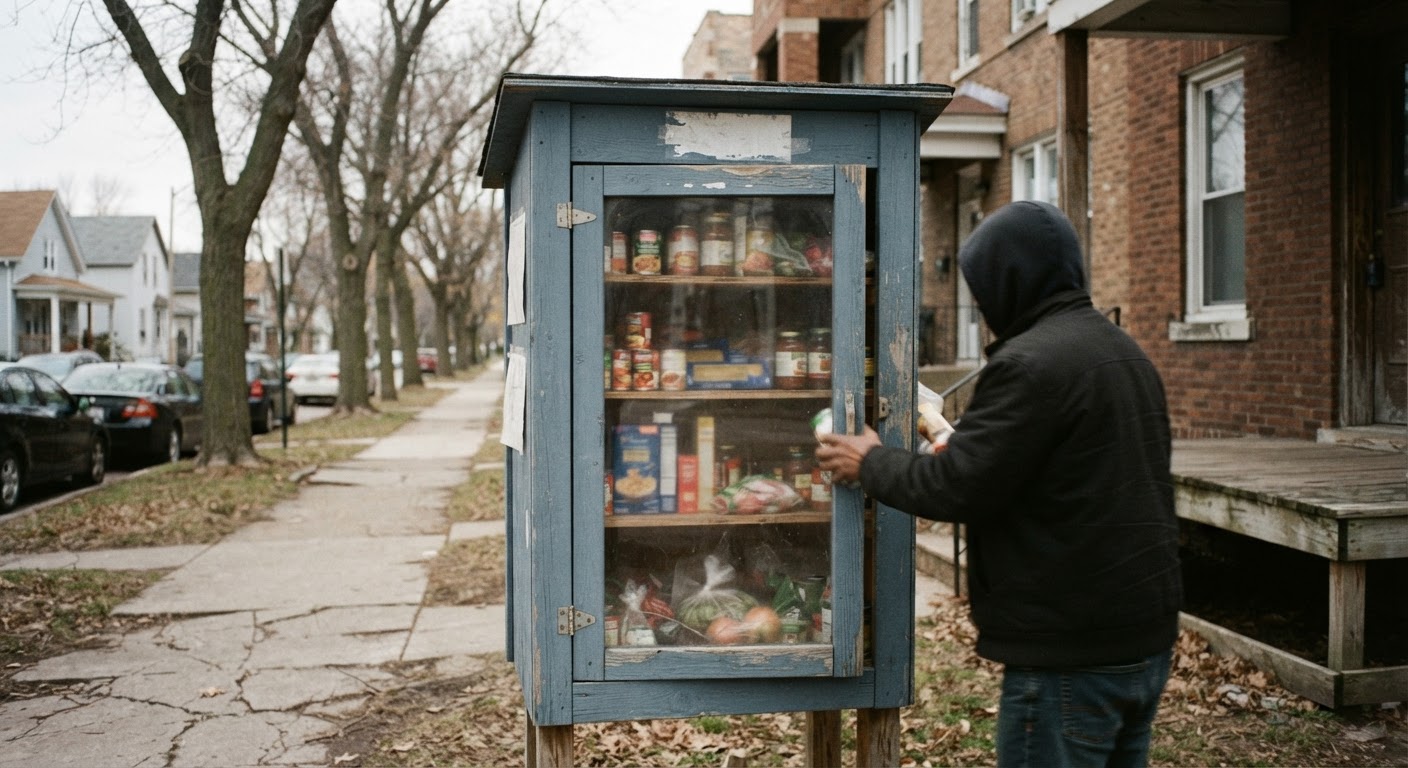
The standing project model. Some networks organize around a recurring need rather than one-off requests — a weekly free grocery table, a community fridge, a diaper bank stocked by regular donations, a phone tree for wellness checks on elderly neighbors. These function more like informal, unincorporated versions of a pantry, but they’re still run by volunteers pooling their own time and resources rather than operating as a registered nonprofit.
The skill-share or labor model. Not everything moves as money or goods. Some mutual aid runs on time and skill — someone who can do basic home repairs offers a few hours a month, someone who speaks a needed language helps translate paperwork, someone with a truck helps people move. This kind of aid is easy to overlook because it doesn’t show up as a “resource” in the way a grant or a food box does, but in a lot of networks it’s the most consistently offered thing.
Whatever the shape, the money and goods usually move fast and with minimal paperwork, because the whole design is built around trust between people who consider themselves part of the same community, rather than verification between an institution and a stranger.
How mutual aid differs from a formal nonprofit grant
It’s worth being direct about this, because the differences cut both ways — mutual aid isn’t simply a faster, friendlier version of a grant program, and it isn’t a full substitute either.
- No eligibility screening, but also no guaranteed capacity. A nonprofit grant fund usually has defined criteria and a budget set aside for a period of time. Mutual aid networks generally don’t screen for eligibility the way a grant program does, but they also don’t have a reliable pool of money sitting in reserve. What’s available on a given day depends entirely on what the network currently has and who’s actively organizing. A network that helped ten families last month might have nothing to offer this month if funds ran low and haven’t been replenished.
- No paperwork, but also no paper trail. You typically won’t fill out a formal application or provide documentation. That’s a relief for a lot of people, especially those who’ve been asked to prove hardship over and over. But it also means there’s no receipt, no case file, and usually no formal follow-up. If something goes wrong — a promised ride doesn’t show, funds take longer than expected — there’s rarely a customer service line to call.
- No tax deductibility, usually. Because most mutual aid networks aren’t registered nonprofits, contributions to them generally aren’t tax-deductible the way a donation to a registered charity would be. This matters more to donors than to people seeking help, but it’s part of why some networks stay small and informal by choice rather than incorporating.
- Reciprocity is expected, not required. Nonprofit grants are one-directional by design — the organization gives, the recipient receives, and that’s the whole transaction. Mutual aid carries an underlying expectation that help flows in multiple directions over time, even if no one tracks or enforces it. You won’t be turned away for not “paying it forward,” but the culture of these networks often assumes you’ll help when you’re able.
- Speed and flexibility versus consistency and scale. A well-funded nonprofit program can often commit to helping the same category of need month after month, year after year, because it has staff and a budget cycle. A mutual aid network can move money to someone within hours of a request, with no committee meeting required — but it may not exist in the same form six months from now, and it may not be able to help with larger or more complex needs, like a security deposit that runs into the thousands.
Neither model is strictly better. If you need something small and time-sensitive and you’re comfortable with an informal, trust-based exchange, mutual aid can be faster than almost anything else available. If you need a larger amount, a sustained commitment, or documentation for some other purpose, a formal grant fund or agency program is usually the better fit, even with the slower process and paperwork that comes with it. Many people end up using both, depending on what the moment calls for.
How to find a mutual aid network in your area
Because mutual aid networks don’t file paperwork with any central registry, there’s no single database that lists them all — but a few approaches tend to work.
- Search social media and local group listings. Many mutual aid networks organize primarily through a social media page or group, often named after the city, neighborhood, or region plus the phrase “mutual aid.” Searching your city or county name alongside that phrase is usually the fastest way to find an active group, though you may need to check whether the page is still active — some form during a specific crisis and go quiet afterward.
- Ask at community hubs that already know the informal landscape. Public librarians, community center staff, tenant organizers, and staff at established food pantries often know which informal networks are currently active in the area, even if those networks don’t have any official presence. These are the people who hear about a new group forming long before it shows up in a search.
- Check with faith communities, even ones you’re not part of. Congregations of all kinds frequently run or host informal aid efforts that function like mutual aid even if they don’t use the term — a benevolence fund passed hand to hand, a meal train, a closet of donated household goods. Many will help people outside their membership; it doesn’t hurt to call and ask what they have going.
- Look for community fridges, free pantries, and little free libraries. These small, unstaffed installations are often maintained by the same informal networks that handle other kinds of mutual aid, and there’s usually contact information posted nearby — a sign, a QR code, a note — for whoever restocks them.
- Ask a 211-style referral line, even though mutual aid isn’t their usual territory. Referral specialists don’t always track informal networks the way they track registered nonprofits, but many keep informal notes on active community efforts precisely because so many callers ask. It’s worth a quick call even if you don’t expect a direct answer.
- When you find one, ask what it can and can’t do before you rely on it. Because capacity shifts constantly, a quick message asking whether the network is currently active and what kinds of requests it’s handling will save you time and disappointment. A network that helped with rent last month may be focused entirely on food this month.
Mutual aid isn’t a replacement for the more structured parts of the assistance landscape, and it isn’t going to run the way an agency program does. But for the kind of need that’s real but doesn’t fit neatly into any program’s category — the gap between paychecks, the ride nobody else can give, the bag of groceries that gets you to Friday — it’s often the fastest door available, and sometimes the only one that opens the same day you knock.